
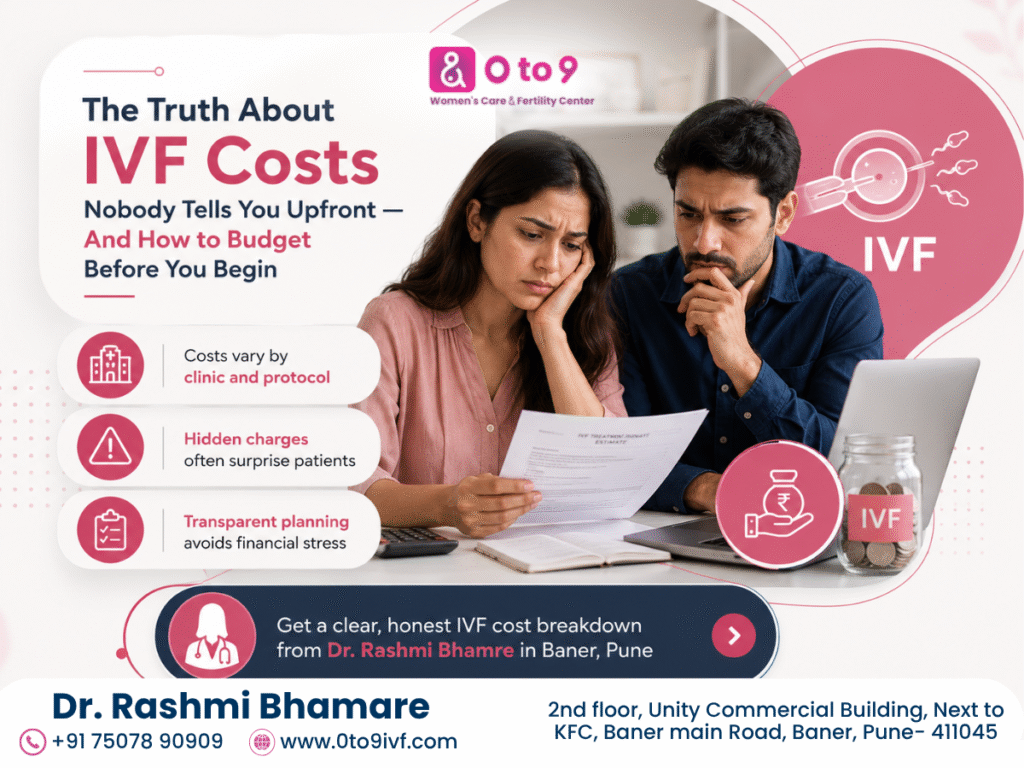
Ask any couple who has gone through IVF what surprised them most, and cost almost always comes up. Not because IVF is secretly unaffordable, but because the number quoted in the first consultation is rarely the number you actually end up paying. Between medications, add-on procedures, and the real possibility of needing more than one cycle, the final bill often looks quite different from the headline price. This guide breaks down what IVF really costs in India, what most clinics leave out of their initial quote, and how to build a realistic budget before you start.
What Does a Basic IVF Cycle Actually Include?
When a clinic quotes you a base price, it typically covers five clinical stages:
- Pre-cycle consultation and fertility testing for both partners
- Ovarian stimulation monitoring through scans and blood tests
- Egg retrieval, a minor surgical procedure done under sedation
- Laboratory fertilisation and embryo culture
- Embryo transfer into the uterus
Across India, this base package generally ranges between roughly Rs 1 lakh and Rs 3 lakh per cycle, depending on the city and clinic, according to multiple published 2026 cost breakdowns from Indian fertility centres. Pune specifically tends to sit toward the more affordable end of this range compared to metro cities like Mumbai and Delhi, which often charge 20 to 50 percent more due to higher rent and operational costs. This is one of the reasons couples researching the best IVF treatment in Pune often find better value without compromising on lab quality or specialist experience.
The Costs Nobody Mentions Upfront
This is where most couples get caught off guard. The base package price is rarely the final bill, and hidden or unbundled costs can add anywhere from 30 to 60 percent on top of the original quote. Common add-ons include:
- Stimulation medication: Often the single biggest additional expense, ranging from roughly Rs 40,000 to Rs 1,20,000 depending on dosage and whether you use branded or generic hormone injections
- ICSI, if required: Adds approximately Rs 15,000 to Rs 50,000 when sperm quality issues call for direct sperm injection into the egg
- Embryo freezing and storage: Typically an additional Rs 20,000 to Rs 40,000, plus annual storage fees if you choose to preserve embryos for future use
- Genetic testing (PGT-A): Can range from Rs 50,000 to over Rs 1,00,000 if you opt for embryo screening, particularly relevant for women over 35
- Donor eggs or sperm: Egg donation can add Rs 1,00,000 to Rs 2,50,000, while sperm donation typically costs Rs 20,000 to Rs 50,000
- Additional diagnostic tests: Hysteroscopy, extra hormone panels, or repeat ultrasounds that were not included in the original quote
A clinic that only shows you the base procedure cost is giving you an incomplete picture. The number that actually matters for your budget is the all-inclusive figure, medications and all.
Why One Cycle Is Rarely the Whole Story
Perhaps the most important thing nobody tells couples upfront is that IVF is often not a one-and-done process. Live birth rates for a single IVF cycle in women under 35 generally fall between 40 and 60 percent, meaning a meaningful percentage of couples will need a second or even third attempt before achieving a successful pregnancy. This is not a reflection of poor treatment; it is simply how IVF works statistically.
The good news is that a second attempt does not always mean paying full price again. If embryos were frozen after the first retrieval, a frozen embryo transfer (FET) typically costs significantly less than a fresh cycle, often somewhere between Rs 40,000 and Rs 1,70,000, compared to a full repeat retrieval. This is why many fertility specialists recommend a freeze-all strategy when clinically appropriate, since one retrieval can sometimes yield multiple embryos for future transfers.
Realistic Budgeting: What Should You Actually Set Aside?
Rather than budgeting for a single cycle in isolation, it is far more realistic to plan for the possibility of two attempts. A reasonable total budget for most couples, accounting for medications and likely add-ons across one to two cycles, tends to fall somewhere between Rs 2 lakh and Rs 6 lakh. Here is how to approach the planning process practically:
- Ask your clinic for a full, itemised cost breakdown before starting, not just the headline package price
- Clarify whether medications are included in the quoted price or billed separately
- Ask directly whether ICSI, embryo freezing, or genetic testing are likely to be needed in your specific case, based on your test results
- Check whether your clinic offers multi-cycle packages, which can reduce the per-cycle cost by 15 to 25 percent for couples who may need more than one attempt
- Ask your HR or insurance provider whether your health policy offers any fertility treatment coverage, since some corporate plans in India have started offering partial support, even though most standard policies still classify IVF as an elective procedure
Choosing a Clinic Based on Value, Not Just Price
It can be tempting to simply choose the clinic with the lowest quoted price, but this can backfire. A clinic with a lower success rate may end up costing you more overall if it means paying for repeated cycles. When researching the best IVF treatment in Pune, it is worth asking clinics directly about their success rates by age group, their embryology lab standards, and whether their pricing is genuinely transparent from the first consultation. A slightly higher upfront cost at a clinic with strong outcomes and honest pricing is often the more financially sound choice in the long run.
Read More –
- IUI vs. IVF vs. ICSI: A Plain-Language Guide for Couples Who Don’t Know Where to Start
- The Two-Week Wait: Essential Precautions for IVF Success
- Preparing for IVF: Lifestyle Changes That May Improve Your Chances of Success
How 0 to 9 Women’s Care Clinic Can Help
Planning for IVF should not feel like navigating a maze of hidden charges and unclear pricing. At 0 to 9 Women’s Care Clinic, Dr. Rashmi Bhamre and the team believe couples deserve complete financial clarity before starting treatment, not surprises halfway through.
We offer some of the best IVF treatment in Pune, backed by transparent, itemised pricing that outlines exactly what is included and what may be needed based on your specific diagnosis. Dr. Rashmi Bhamre takes the time to walk couples through realistic cost expectations, including medication needs, the likelihood of requiring additional cycles, and any add-on procedures that may apply to their case. If you are searching for the best IVF treatment in Pune with honest guidance and a clear financial roadmap, reach out to 0 to 9 Women’s Care Clinic to schedule a consultation and start your journey with clarity, not confusion.
Frequently Asked Questions
- What is the average cost of one IVF cycle in India?
A basic IVF cycle in India typically costs between Rs 1 lakh and Rs 3 lakh, depending on the city and clinic. This usually covers consultation, monitoring, egg retrieval, fertilisation, and embryo transfer, but medications and add-on procedures are often billed separately, so it is important to confirm the all-inclusive price beforehand. - Does health insurance cover IVF treatment in India?
Most standard health insurance policies in India do not cover IVF, since it is typically classified as an elective procedure rather than a medical emergency. However, some corporate employer health plans, particularly in the technology and financial services sectors, have begun offering partial fertility treatment coverage, so it is worth checking with your HR or benefits team. - Why do some couples need more than one IVF cycle?
IVF success rates for a single cycle generally range from 40 to 60 percent for women under 35, meaning not every attempt results in pregnancy on the first try. This is a normal part of the process rather than a treatment failure, and couples who freeze embryos after their first retrieval often pay significantly less for a subsequent frozen embryo transfer compared to a full repeat cycle.
#IVFCostGuide #BestIVFTreatmentInPune #FertilityBudgeting #IVFJourney #InfertilityAwareness #WomensHealth #TryingToConceive #FertilityPlanning