
When to Consult a Gynecologist in Pune About One-Sided Pelvic Pain
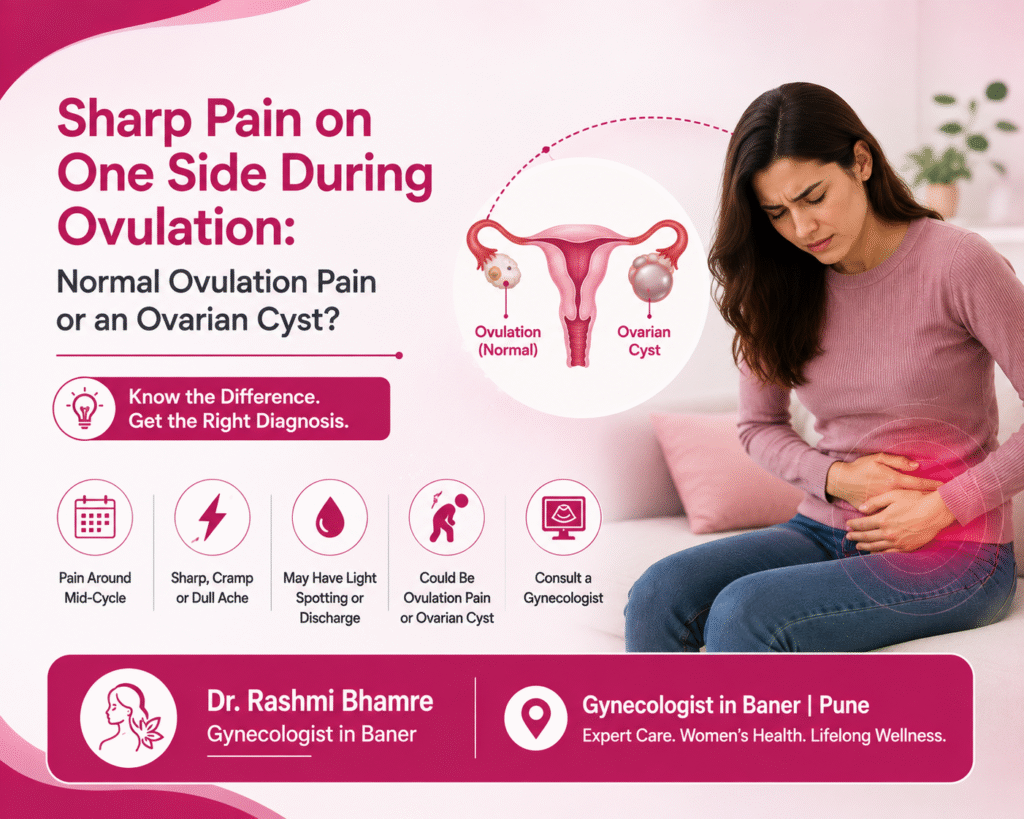
A sudden, sharp pain on one side of the lower abdomen around the middle of your menstrual cycle may be ovulation pain. For some women, it feels like a quick pinch. For others, it causes cramping or an uncomfortable ache that lasts several hours.
The timing may make ovulation seem like the obvious explanation, but ovarian cysts, endometriosis, pelvic infections and pregnancy-related conditions can produce similar pain. The intensity and location of pain alone cannot provide a reliable diagnosis.
Occasional mild discomfort that follows a predictable mid-cycle pattern is usually not concerning. Pain that is severe, persistent, worsening or accompanied by nausea, vomiting or abnormal bleeding should be assessed by a Gynecologist.
What Does Normal Ovulation Pain Feel Like?
Ovulation pain is also called mittelschmerz, a term meaning “middle pain.” It occurs when an ovary releases an egg, typically around the middle of the menstrual cycle.
According to MedlinePlus, approximately one in five women experiences pain around ovulation. The pain may occur shortly before, during or after the egg is released.
Typical ovulation pain:
- Affects one side of the lower abdomen or pelvis
- Feels like a sharp twinge, cramp or dull ache
- Occurs around the middle of the cycle
- Lasts from a few minutes to several hours, but can continue for up to 24 to 48 hours
- May be accompanied by light spotting or increased vaginal discharge
The pain may alternate sides between cycles, depending on which ovary releases an egg. However, it can also appear on the same side for several cycles.
The NHS similarly notes that ovulation pain generally lasts from a few minutes to one or two days and commonly occurs around 14 days before the next period. The exact day depends on the length and regularity of your cycle.
Why Can Releasing an Egg Cause Pain?
Before ovulation, the follicle containing the developing egg grows inside the ovary. This growth may stretch the ovary’s surface and cause discomfort.
When the follicle opens to release the egg, a small amount of fluid or blood may also enter the pelvis. This can temporarily irritate the lining of the abdominal cavity and produce a sharp sensation.
Normal ovulation pain is not harmful and does not damage fertility. However, recurring mid-cycle pain should not automatically be labelled as ovulation pain without considering other conditions.
Ovulation Pain Versus an Ovarian Cyst
| Feature | Typical ovulation pain | Possible ovarian cyst |
| Timing | Usually around the middle of the cycle | Can occur at any point in the cycle |
| Duration | Minutes to one or two days | May persist, recur or gradually worsen |
| Sensation | Brief twinge, cramp or dull ache | Pressure, heaviness or sharp pelvic pain |
| Other symptoms | Mild spotting or ovulation discharge | Bloating, painful sex, urinary pressure or menstrual changes |
| Emergency pattern | Severe pain is uncommon | Sudden severe pain may occur with rupture or torsion |
These patterns can provide clues but cannot confirm the diagnosis. A Gynecologist may recommend an ultrasound when symptoms are persistent, severe or atypical.
What Is an Ovarian Cyst?
An ovarian cyst is a fluid-filled sac that develops in or on an ovary. Many cysts are part of the normal menstrual cycle.
A functional cyst may form when a follicle does not release an egg or does not shrink normally after ovulation. Functional cysts are usually benign and often disappear without treatment within a few months.
According to the NHS ovarian cyst guidance, cysts commonly produce no symptoms. Symptoms are more likely when a cyst becomes large, ruptures or causes the ovary to twist.
Not every ovarian cyst requires medicine or surgery. Management depends on its size, ultrasound appearance, symptoms, age and whether the patient has reached menopause.
Signs That Pain May Be Related to an Ovarian Cyst
An ovarian cyst may be more likely when the pain:
- Continues beyond one or two days or occurs outside the expected ovulation window
- Creates ongoing pressure or heaviness in the pelvis
- Occurs during sexual intercourse or bowel movements
- Is associated with bloating, abdominal swelling or feeling full quickly
- Appears with frequent urination or pressure on the bladder
- Occurs alongside heavy, irregular or unusually light periods
A cyst may also be discovered incidentally during an ultrasound performed for another reason. The presence of a cyst does not always mean it is responsible for the pain.
Could a Cyst Rupture?
Yes. An ovarian cyst can occasionally break open and release fluid or blood into the pelvis. Some ruptured cysts cause only mild pain and settle with observation and appropriate pain relief.
Other ruptures can cause sudden, intense pain or internal bleeding. Johns Hopkins Medicine explains that severe lower abdominal pain and significant bleeding after cyst rupture require immediate medical care.
A suspected rupture should be evaluated according to the severity of symptoms. Do not assume that sudden severe pain is a routine part of ovulation.
What Is Ovarian Torsion?
Ovarian torsion occurs when an ovary twists around the tissues supporting it, potentially reducing or stopping its blood supply. An ovarian cyst or enlarged ovary may increase the risk, although torsion can sometimes occur without a known cyst.
The pain is usually sudden and severe. Nausea and vomiting are common warning signs. Pain may occasionally come and go if the ovary twists and partially untwists.
Torsion is a medical emergency because delayed treatment can damage the ovary. MedlinePlus identifies sudden severe pelvic pain with nausea and vomiting as a possible sign of ovarian torsion or cyst rupture.
Other Conditions That Can Resemble Ovulation Pain
One-sided pelvic pain is not always coming from an ovary. Other possibilities include endometriosis, pelvic inflammatory disease, scar tissue following surgery, urinary tract problems, kidney stones, bowel conditions or appendicitis.
An ectopic pregnancy can also cause one-sided pelvic pain. It should be considered whenever pregnancy is possible, even if the pain seems to occur near the expected ovulation date.
Endometriosis may be more likely if the pain occurs with very painful periods, pain during sex, painful bowel movements or difficulty conceiving. The NHS notes that endometriosis can affect the ovaries, fallopian tubes and surrounding pelvic tissues.
A Gynecologist will consider the complete pattern rather than diagnosing solely from the location of pain.
Warning Signs That Need Urgent Medical Assessment
Seek urgent medical attention if you experience:
- Sudden or severe pelvic or abdominal pain
- Pain accompanied by nausea or vomiting
- Fainting, significant dizziness, weakness or pale skin
- Heavy vaginal bleeding
- Fever or foul-smelling vaginal discharge
- Shoulder-tip pain or pain with a positive pregnancy test
- Increasing abdominal swelling or difficulty breathing
These symptoms may indicate torsion, internal bleeding, ectopic pregnancy or infection. Waiting to see whether the pain disappears may not be safe when these warning signs are present.
How Will a Gynecologist Identify the Cause?
The evaluation may include:
- Symptom and cycle history: The Gynecologist will ask when the pain began, how long it lasts, which side is affected and whether it follows a predictable cycle pattern.
- Pregnancy test: This is important whenever pregnancy is possible because an ectopic pregnancy can cause one-sided pain.
- Abdominal and pelvic examination: The examination may identify tenderness, swelling or signs of infection.
- Pelvic ultrasound: An abdominal or transvaginal ultrasound can examine the ovaries, uterus and surrounding structures. It may reveal a cyst and help assess its size and internal appearance.
- Additional tests: Blood tests, urine testing or vaginal samples may be advised when bleeding, infection, anaemia or another condition is suspected.
An ultrasound showing a cyst does not automatically mean surgery is needed. A repeat scan may be recommended to confirm whether a functional cyst resolves naturally.
Managing Mild Ovulation Pain
If the pain is mild, brief and clearly follows a mid-cycle pattern, rest, a warm compress or a warm bath may help. Over-the-counter pain relief may be suitable for some people, but check with a doctor or pharmacist if you have a stomach ulcer, kidney condition, medication allergy, take blood-thinning medicine or could be pregnant.
Tracking the first day of each period, the day pain occurs and how long it lasts can reveal whether the discomfort consistently matches ovulation.
If ovulation pain repeatedly disrupts work, sleep, exercise or sexual activity, consult a Gynecologist. Hormonal contraception can prevent ovulation and may help some patients, but it is not appropriate for someone actively trying to conceive and should only be used after medical consultation.
Consult a Gynecologist in Pune at 0 to 9 Women’s Care & Fertility Center
One-sided mid-cycle pain may be normal ovulation discomfort, but persistent or severe pain deserves a proper assessment. Identifying whether the cause is ovulation, a functional cyst, endometriosis or another pelvic condition helps avoid both unnecessary worry and delayed treatment.
At 0 to 9 Women’s Care & Fertility Center, Dr. Rashmi Bhamare can evaluate the pain pattern, perform a gynaecological assessment and recommend appropriate investigations. If you are looking for a Gynecologist in Pune, the clinic can assist with ovulation pain, ovarian cysts, menstrual concerns and fertility-related pelvic symptoms.
This article is for general education and does not replace an individual medical examination or diagnosis.
Frequently Asked Questions
1. How long should normal ovulation pain last?
Ovulation pain usually lasts from a few minutes to several hours, although it may continue for up to one or two days. Consult a Gynecologist if the pain lasts longer, keeps returning outside mid-cycle or becomes more severe than usual.
2. Can an ovarian cyst feel exactly like ovulation pain?
Yes. Both can produce one-sided pelvic pain, so symptoms may overlap. Persistent pressure, bloating, painful intercourse, menstrual changes or pain outside the expected ovulation window may suggest a cyst. A pelvic ultrasound is commonly used to investigate.
3. Does sharp ovulation pain mean an ovarian cyst has ruptured?
Not necessarily. Normal ovulation can cause a brief sharp twinge when the follicle releases an egg. A rupture is more concerning when pain is sudden and severe or occurs with heavy bleeding, dizziness, nausea, vomiting or weakness. These symptoms need urgent medical assessment.