
Understanding Your Options for Infertility Treatment
Hearing that one or both fallopian tubes may be blocked can be upsetting, but it does not automatically mean pregnancy is impossible. The outlook depends on whether the blockage affects one tube or both, where it is located, how damaged the tubes are, your age, ovarian reserve, sperm health and whether another fertility condition is present.
Fallopian tubes do more than carry an egg toward the uterus. Fertilisation usually happens inside a tube, after which the early embryo travels to the uterus for implantation. A blockage can prevent sperm from reaching the egg or stop the fertilised egg from reaching the uterus safely.
The World Health Organization states that infertility affects about one in six people of reproductive age during their lifetime. It also identifies blocked fallopian tubes as one possible female factor, often associated with untreated reproductive tract infections or complications after abdominal or pelvic surgery. These figures show how common fertility difficulties are, but they do not predict an individual person’s chance of pregnancy. Source: World Health Organization
What Does It Mean If One or Both Tubes Are Blocked?
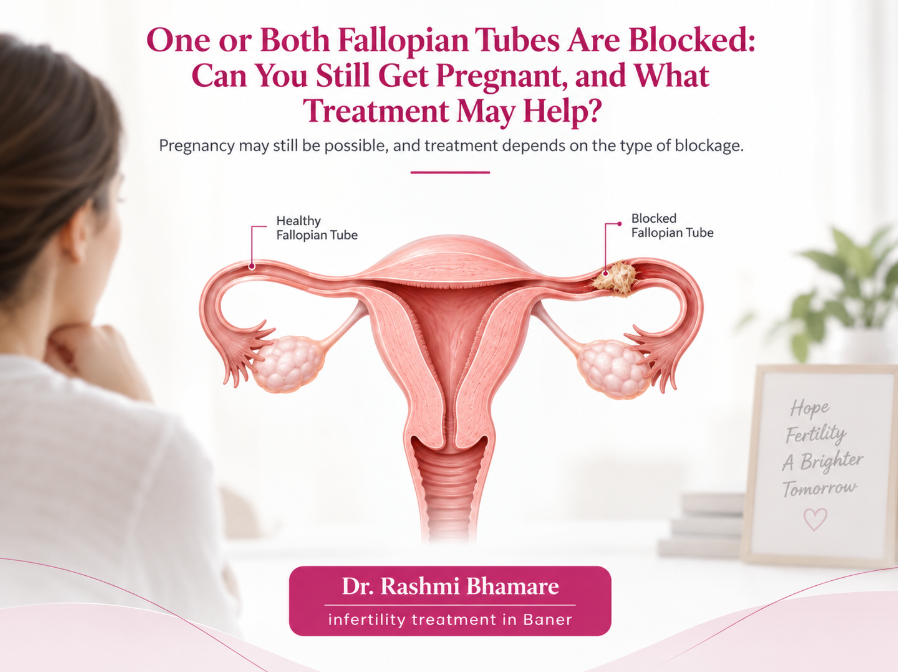
The result has different implications depending on the number of tubes affected and the condition of the remaining tube.
- One tube is blocked: Natural pregnancy may still be possible if the other tube is open and healthy, ovulation occurs and there are no major sperm or uterine factors. Ovulation does not follow a perfectly predictable left and right pattern, so conception may take time.
- Both tubes are completely blocked: Egg and sperm usually cannot meet naturally. In this situation, infertility treatment may involve opening selected blockages or using in vitro fertilisation, commonly called IVF, to bypass the tubes.
- A tube is partly blocked or damaged: Pregnancy may sometimes occur, but the risk of an ectopic pregnancy can be higher because a fertilised egg may not travel normally to the uterus. ACOG notes that more than 90 percent of ectopic pregnancies occur in a fallopian tube. Source: American College of Obstetricians and Gynecologists
A reported blockage also needs careful interpretation. A tube can appear blocked because of temporary muscular spasm, mucus or technical factors during testing. This is especially relevant when the apparent blockage is close to the uterus.
Why Do Fallopian Tubes Become Blocked?
Common causes include pelvic inflammatory disease, previous chlamydia or gonorrhoea infection, endometriosis, scar tissue after pelvic or abdominal surgery, a past ectopic pregnancy and previous tubal sterilisation. Some people have no symptoms and discover the problem only during a fertility evaluation.
A hydrosalpinx is a particular type of tubal damage in which the tube becomes blocked and fills with fluid. It deserves specific attention because the fluid and underlying tubal disease may reduce the chance of successful embryo implantation.
The American Society for Reproductive Medicine, or ASRM, advises that treatment of an irreparable hydrosalpinx with removal or disconnection of the affected tube can improve IVF pregnancy outcomes. Source: ASRM committee opinion
How Is Tubal Blockage Confirmed Before Infertility Treatment?
A fertility assessment should look at both partners rather than focusing only on the tubes. The plan may include:
- Hysterosalpingography, or HSG: Contrast dye is passed through the uterus while X-ray images show whether it flows through the tubes. ASRM describes HSG as the standard first-line test for tubal patency. However, it can falsely suggest a blockage near the uterus. In studies reviewed by ASRM, about 60 percent of patients with proximal blockage on an initial HSG had open tubes on a repeat HSG one month later.
- Ultrasound-based tubal testing: A saline and air or contrast ultrasound may assess the uterine cavity and tubal flow without a conventional X-ray.
- Laparoscopy with dye testing: This may be recommended when endometriosis, pelvic adhesions or another condition requiring surgery is suspected. It allows the doctor to view the pelvis directly, but it is not automatically necessary for everyone.
- Complete fertility evaluation: Ovulation, ovarian reserve, uterine health and semen analysis matter because tubal treatment alone will not correct another significant fertility factor.
The ASRM patient guide explains that an HSG is generally an outpatient test and that the next step after a blocked result may be laparoscopy or IVF, depending on the clinical picture. Source: ASRM HSG patient guide
Which Infertility Treatment May Help?
There is no single best treatment for every blocked tube. A personalised decision generally considers the site and severity of disease, age, ovarian reserve, semen findings, previous pregnancy history, time already spent trying, the number of children desired and the couple’s preferences.
- Trying naturally with one healthy tube: If one tube is open, the ovaries are functioning and semen results are suitable, a doctor may recommend timed intercourse for a defined period. The time allowed should be individualised, especially when age or ovarian reserve makes delay important.
- Ovulation induction with IUI: Intrauterine insemination places prepared sperm inside the uterus, but fertilisation still depends on an open, functioning tube. It may be considered in selected cases of unilateral blockage when at least one tube is usable and there is an additional reason to use IUI. It does not bypass bilateral complete blockage.
- Tubal cannulation: A fine catheter and guidewire may sometimes open a proximal blockage near the uterus. ASRM recommends considering this approach in appropriately selected younger patients without other major infertility factors. Reblocking can occur, so follow-up and realistic counselling are important.
- Laparoscopic tubal surgery: Surgery may remove scar tissue or repair selected distal disease. Results depend heavily on the extent of damage and the surgeon’s experience. The NHS notes that tubal surgery can help clear scar tissue, while also acknowledging ectopic pregnancy as a possible complication. Source: NHS infertility treatment guidance
- IVF: Eggs are collected from the ovaries and fertilised in a laboratory, after which an embryo is placed into the uterus. This bypasses the fallopian tubes and is often considered when both tubes are blocked, the damage is severe, hydrosalpinx is present, previous repair has failed or other fertility factors coexist.
IVF success is not guaranteed and depends on individual factors, particularly age and ovarian reserve. The CDC cautions that national or clinic averages cannot predict one person’s outcome. Source: CDC ART success rates
When Should You Seek a Fertility Evaluation?
General guidance recommends evaluation after 12 months of regular unprotected intercourse when the female partner is under 35, or after six months from age 35 onward. Assessment should begin sooner when there is a known or suspected tubal problem, previous ectopic pregnancy, endometriosis, pelvic infection, pelvic surgery or another factor that may affect fertility.
If pregnancy occurs after tubal disease or tubal surgery, contact your clinician early. Prompt blood tests and an early ultrasound may be advised to confirm that the pregnancy is developing inside the uterus.
Seek urgent medical care for severe one-sided pelvic pain, shoulder-tip pain, fainting, marked dizziness or heavy bleeding, as these can be warning signs of an ectopic pregnancy.
A Personalised Plan for Infertility Treatment in Baner
A blocked tube is not a complete fertility diagnosis. The most useful next step is to confirm what the test actually shows and assess the full reproductive picture before choosing treatment.
At 0 to 9 Women’s Care & Fertility Center, Dr. Rashmi Bhamare can evaluate tubal findings alongside ovulation, ovarian reserve, uterine health and semen results.
For people seeking infertility treatment in Baner, the aim is to explain whether natural attempts, IUI, tubal intervention or IVF is medically reasonable for their situation, without making unrealistic promises.
This article is for general education and does not replace an individual medical consultation.
Frequently Asked Questions
1. Can I get pregnant naturally if one fallopian tube is blocked?
Yes, natural pregnancy may still be possible when the other tube is open and healthy, ovulation occurs and there are no significant sperm or uterine factors. The chance and appropriate waiting period depend on age, ovarian reserve and how long you have already been trying. A fertility specialist can help confirm that the apparently open tube is functional and advise when infertility treatment should be considered.
2. Can IUI work when both fallopian tubes are blocked?
IUI does not bypass the fallopian tubes. It places sperm inside the uterus, but the sperm and egg still normally need to meet inside an open tube. Therefore, IUI is generally not suitable for confirmed complete blockage of both tubes. IVF is commonly discussed because fertilisation occurs outside the body and the embryo is transferred directly into the uterus.
3. Is IVF always necessary for blocked fallopian tubes?
No. IVF is not automatically necessary when one healthy tube remains open or when a selected proximal blockage can be treated with tubal cannulation.
It may be the more appropriate infertility treatment when both tubes are completely blocked, tubal damage is severe, hydrosalpinx is present, age makes delay important or other fertility factors exist. The decision should follow complete evaluation and shared discussion with a fertility specialist.
#infertilitytreatment #fallopiantubes #tubalfactorinfertility #fertilitycare #ivftreatment #iuitreatment #womenshealth #fertilityspecialist #infertilitytreatmentinbaner #baner