
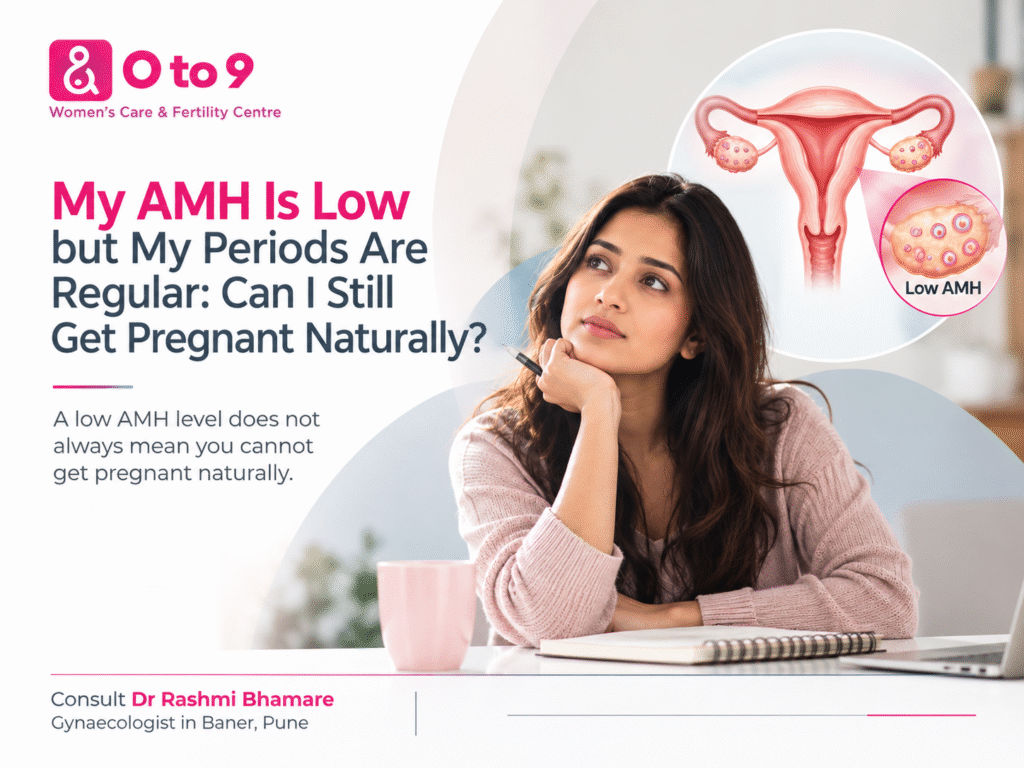
Yes, getting pregnant naturally is still possible even if your Anti-Müllerian Hormone (AMH) level is low and your periods are regular. A low AMH result may indicate a reduced ovarian reserve, but it does not automatically mean infertility. Regular menstrual cycles are also a reassuring sign that ovulation is likely occurring.
Your chances of pregnancy depend on several factors, including age, egg quality, ovulation, sperm health and fallopian tube function. Understanding what AMH actually measures can help you make informed decisions without unnecessary worry.
What Does a Low AMH Level Actually Mean?
AMH is a hormone produced by small, developing follicles in the ovaries. An AMH blood test helps estimate ovarian reserve, which refers to the remaining supply of eggs.
A lower AMH level may suggest fewer developing follicles than expected for your age. However, the test cannot accurately determine how many eggs remain or whether you can conceive naturally.
There is also an important difference between egg quantity and egg quality.
AMH mainly provides information about egg quantity. It does not directly measure whether an egg can be fertilised or develop into a healthy pregnancy.
According to the American Society for Reproductive Medicine (ASRM), ovarian reserve tests are useful for predicting ovarian response during fertility treatment, but they are poor independent predictors of natural pregnancy.
Why Are My Periods Regular Even Though My AMH Is Low?
Regular periods and ovarian reserve measure different aspects of reproductive health.
A menstrual cycle generally occurs through hormonal changes that prepare an egg for release and the uterus for a possible pregnancy.
Women with regular cycles, typically between 21 and 35 days, are likely to ovulate. However, regular bleeding does not guarantee ovulation in every cycle.
Even when ovarian reserve is reduced, the ovaries may continue releasing eggs. This explains why someone can have a low AMH result while still experiencing predictable periods.
The 2026 NICE fertility guideline specifically advises against using AMH to predict the chance of spontaneous pregnancy.
Can You Conceive Naturally With Low AMH?
Natural conception remains possible because pregnancy does not depend on having a high AMH value alone.
For pregnancy to occur, an egg must be released, sperm must reach and fertilise it, and the resulting embryo must develop and implant successfully.
Research involving women without diagnosed infertility has found that lower AMH levels do not reliably predict how quickly they will become pregnant.
This does not mean AMH is irrelevant. A low result may influence future fertility planning, particularly when combined with increasing age or other reproductive concerns.
However, one blood test should never be treated as a final prediction of your fertility.
The appropriate next step depends on your age, reproductive history and how long you have been trying to conceive.
Does Age Matter More Than AMH for Natural Pregnancy?
Age is generally a stronger predictor of reproductive potential than AMH alone.
As women grow older, both the number and quality of eggs decline. Age-related changes in egg quality can affect fertilisation, embryo development and pregnancy outcomes.
For example, a younger woman with low AMH may have a different reproductive outlook from an older woman with a similar result.
This is why fertility specialists interpret AMH alongside age rather than relying on an isolated number.
A low result should encourage an informed discussion about reproductive plans, not an assumption that pregnancy is impossible.
What Should You Do After Receiving a Low AMH Report?
Before considering infertility treatment, it helps to understand your complete reproductive health.
A fertility specialist may recommend:
- Reviewing your AMH report: Considering your age, laboratory reference range, hormonal contraceptive use and previous results.
- Assessing ovarian reserve: An ultrasound to measure antral follicle count may provide additional information when clinically useful.
- Reviewing ovulation: Menstrual history is often informative, although progesterone testing may be considered during fertility investigations.
- Checking other fertility factors: Depending on your history, semen analysis and assessment of fallopian tube function may be appropriate.
- Discussing your pregnancy plans: Your age, previous pregnancies and duration of trying help determine whether further assessment is needed.
Not everyone requires every investigation. Tests should be selected according to the patient’s individual circumstances.
When Should You Consult a Fertility Specialist?
Seeking medical advice at the appropriate time can help identify factors that may be affecting conception.
ASRM recommends fertility evaluation after:
- 12 months of regular, unprotected intercourse if the female partner is younger than 35.
- 6 months if the female partner is 35 or older.
- An earlier assessment if the female partner is over 40 or there is a known reproductive condition.
A consultation may also be reasonable sooner when an unexpectedly low AMH result raises concerns about future pregnancy planning, particularly alongside other risk factors.
During this consultation, the specialist can explain whether continued natural attempts, further evaluation or treatment is appropriate.
Does Low AMH Mean You Need IVF Immediately?
No. A low AMH result alone does not mean that in vitro fertilisation (IVF) is necessary.
Some women may continue trying naturally, while others may benefit from additional investigations or fertility treatment.
If IVF becomes appropriate, AMH can help doctors estimate how the ovaries may respond to stimulation medicines. Lower ovarian reserve may mean fewer eggs are retrieved, but AMH cannot independently predict treatment success.
Options may include continued natural attempts, treatment of an underlying condition, intrauterine insemination (IUI) or IVF, depending on the complete fertility assessment.
The decision should consider possible benefits, limitations, treatment burden and individual circumstances.
Frequently Asked Questions
1. Can low AMH cause early menopause?
Low AMH may be associated with declining ovarian reserve, but a single result cannot reliably predict when menopause will begin. Menstrual history, age and other clinical findings are more useful for understanding individual concerns.
2. Can AMH levels improve naturally?
AMH measurements can vary, and factors such as hormonal contraception may affect results. However, an increase in the measured value does not necessarily mean that egg reserve has increased. No supplement or lifestyle change has been established as a reliable way to restore the remaining egg supply.
3. Should I stop trying naturally because my AMH is low?
Not necessarily. Low AMH alone is not a reason to stop trying for natural pregnancy. Your age, duration of trying and other fertility findings should guide the decision. If you are concerned about delaying treatment, discuss an individual plan with a fertility specialist.
Conclusion
A low AMH level with regular periods does not automatically mean you cannot conceive naturally. AMH provides information about ovarian reserve, but it cannot independently determine your chances of pregnancy.
If you have received a low AMH report or are experiencing difficulty conceiving, consult Dr. Rashmi Bhamare at 0 to 9 Women’s Care and Fertility Centre to discuss your reproductive health and whether further evaluation is appropriate.
For personalised guidance about infertility treatment in Baner, a fertility consultation can help you understand your options and plan your next steps.