
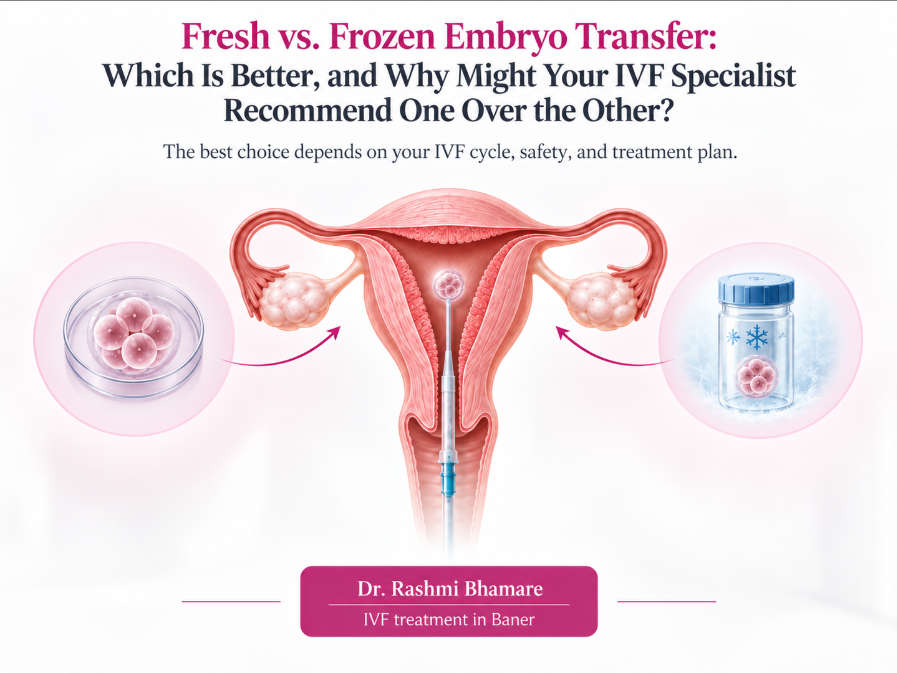
Understanding Embryo Transfer During IVF Treatment in Baner
When embryos are ready during an IVF cycle, one of the next decisions is whether to transfer an embryo in the same treatment cycle or freeze it for transfer later. Patients often ask which option is better. The honest answer is that neither fresh nor frozen embryo transfer is automatically best for everyone.
The recommendation depends on the response to ovarian stimulation, hormone levels, uterine lining, embryo development, risk of ovarian hyperstimulation syndrome, whether genetic testing is planned and the patient’s medical history. A good IVF plan considers safety as well as the chance of pregnancy.
What Is the Difference Between Fresh and Frozen Embryo Transfer?
During a fresh embryo transfer, an embryo is placed into the uterus a few days after egg retrieval. This means ovarian stimulation, egg collection, fertilisation and embryo transfer happen within the same treatment cycle.
During a frozen embryo transfer, suitable embryos are cryopreserved, usually through a rapid-freezing method called vitrification. The embryo is warmed and transferred in a later menstrual cycle after the uterine lining has been prepared.
Modern vitrification has made embryo freezing an established part of IVF care. The UK Human Fertilisation and Embryology Authority, or HFEA, explains that not every embryo is suitable for freezing and that only embryos assessed as appropriate are normally cryopreserved. Source: HFEA embryo freezing guidance
Fresh vs. Frozen Transfer at a Glance
The practical differences can be summarised as follows:
- Timing: A fresh transfer happens shortly after egg retrieval, while a frozen transfer happens in a later cycle.
- Hormonal environment: Fresh transfer takes place while the body is still responding to ovarian stimulation. Frozen transfer allows hormone levels to settle before the uterine lining is prepared.
- Treatment duration: Fresh transfer may shorten the time to the first pregnancy test. Frozen transfer involves additional waiting and preparation.
- OHSS risk: A freeze-only approach can reduce the risk of moderate or severe ovarian hyperstimulation syndrome in patients who respond strongly to stimulation.
- Genetic testing: When preimplantation genetic testing is performed, embryos are generally frozen while results are awaited.
- Cost and medication: Frozen transfer may involve additional monitoring, medicines and laboratory charges, depending on the protocol.
These differences do not mean one route always gives a higher success rate. Patient selection strongly affects published statistics. For example, frozen transfer data may include embryos that were considered suitable enough to survive freezing, while fresh transfer groups may include different patient profiles.
When Might a Fresh Embryo Transfer Be Recommended?
A fresh transfer may be reasonable when the patient has responded safely to ovarian stimulation, hormone levels are suitable, the uterine lining appears receptive and there is no clinical reason to delay transfer.
Possible reasons include:
- A low risk of ovarian hyperstimulation syndrome, commonly called OHSS
- A suitable endometrial lining and acceptable progesterone level
- No need to wait for genetic testing results
- No uterine or medical issue requiring treatment before transfer
- A preference to proceed without delaying the first transfer, when clinically appropriate
A fresh transfer avoids the extra freezing and warming step. However, it should not be chosen only because it appears faster. If the hormonal environment is unsuitable or the patient is at risk of complications, waiting may be safer.
Why Might Your Specialist Recommend a Frozen Transfer?
A frozen transfer may be recommended for several medical or practical reasons:
- High risk of OHSS: The American Society for Reproductive Medicine states that avoiding fresh transfer and freezing all suitable embryos significantly reduces moderate to severe OHSS in patients with a high ovarian response or elevated oestradiol. Source: ASRM OHSS guideline
- Hormone levels are not ideal: Premature progesterone elevation or another hormonal concern may affect endometrial timing.
- The uterine lining needs attention: A thin lining, suspected polyp, fibroid affecting the cavity or fluid within the uterus may need evaluation or treatment first.
- Preimplantation genetic testing is planned: Embryos are biopsied and frozen while laboratory results are processed.
- Hydrosalpinx or another medical issue is present: Treatment before embryo transfer may be recommended to improve safety or the implantation environment.
- Scheduling a later transfer is medically helpful: A later natural or medicated cycle may allow more controlled preparation of the endometrium.
Freezing embryos does not guarantee implantation. An embryo must survive warming, continue developing and implant successfully. Laboratory quality and individual reproductive factors remain important.
Does a Frozen Transfer Have a Higher Success Rate?
Not for every patient.
A multicentre randomised trial involving 2,157 ovulatory women compared fresh and frozen embryo transfer during a first IVF cycle. Live birth after the first transfer was 48.7 percent in the frozen group and 50.2 percent in the fresh group, which was not a statistically significant difference. OHSS occurred less often following the frozen strategy. Source: New England Journal of Medicine study indexed on PubMed
Research in patients with PCOS and a high ovarian response has found different results, including lower OHSS risk and, in some groups, better first-transfer outcomes with frozen embryos. This is why a finding from one patient population should not be applied to everyone.
The HFEA also notes that evidence does not support routine freeze-all treatment as a proven way to improve the chance of having a baby for every patient. Source: HFEA elective freeze-all review
Are Pregnancy Risks Different?
Most pregnancies after fresh or frozen transfer progress normally, but studies have identified different patterns of risk. Frozen transfer has been associated in some research with a lower chance of babies being small for gestational age and a higher chance of larger birth weight or hypertensive disorders. Fresh transfer has been associated with a higher risk of lower birth weight or preterm birth in some comparisons.
These are population-level associations, not predictions for an individual pregnancy. The method used to prepare a frozen transfer, patient health, embryo number and other factors may influence outcomes. Your specialist should explain the reason for the recommended protocol rather than describing frozen or fresh transfer as universally safer.
Choosing the Right IVF Treatment in Baner
The most appropriate decision is based on the complete cycle, not only on whether an embryo can be transferred immediately. Age, embryo quality, ovarian response, hormone results, endometrial development and safety risks should be reviewed together.
At 0 to 9 Women’s Care & Fertility Center, Dr. Rashmi Bhamare can review these factors and explain why a fresh transfer, frozen transfer or delayed transfer may be considered. Patients exploring IVF treatment in Baner can receive an individual plan based on their test results and response to treatment, without unrealistic guarantees.
This article is for general education and does not replace personalised medical advice.
Frequently Asked Questions
1. Is a frozen embryo weaker than a fresh embryo?
No. Modern vitrification allows many suitable embryos to survive freezing and warming. However, not every embryo is suitable for freezing and not every frozen embryo survives warming. Embryo quality, laboratory processes and patient factors all influence the chance of implantation.
2. How long after egg retrieval is a frozen embryo transferred?
Timing varies. Some patients may have a transfer in the next menstrual cycle, while others need more time for recovery, test results or treatment of a uterine or medical issue. The endometrium can be prepared through a natural ovulation cycle or with prescribed hormones.
3. Can I choose between fresh and frozen embryo transfer?
Patient preference matters, but the decision should be made with the IVF specialist. A fresh transfer may not be medically advisable when OHSS risk is high, hormone levels are unsuitable, genetic testing is pending or the uterine environment needs attention.
#ivftreatment #embryotransfer #frozenembryotransfer #freshembryotransfer #fertilitycare #fertilityspecialist #ivftreatmentinbaner #infertilitysupport #womenshealth #banerpune