
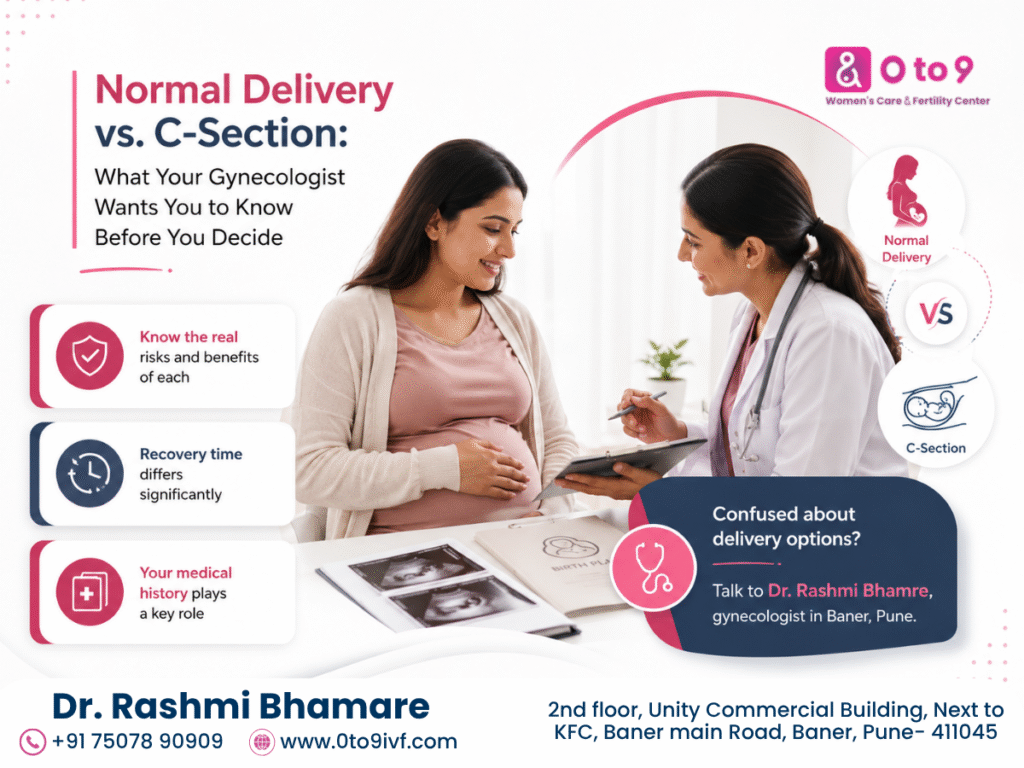
If you are pregnant and constantly Googling “normal delivery vs C-section,” you are not alone. It is one of the most common questions expecting parents bring up in the clinic, often somewhere around the third trimester, when the due date suddenly feels very real.
The truth is, there is no universal “better” option. Both normal (vaginal) delivery and cesarean section are safe, medically established ways to bring a baby into the world. What matters is understanding what each involves, so you can have an informed conversation with your doctor instead of feeling pressured by internet forums or well-meaning relatives.
This is exactly the kind of conversation Dr. Rashmi Bhamre has with her patients every week. As a practicing gynecologist in Baner, she believes decisions about childbirth should be guided by medical facts and a woman’s individual health profile, not fear or trends.
Understanding the Two Options
Normal delivery (vaginal birth) happens when the baby is born through the birth canal, with the body going through natural labor. A cesarean section (C-section) is a surgical procedure where the baby is delivered through incisions made in the abdomen and uterus.
Globally, cesarean rates have risen sharply over the past three decades, from around 7 percent of all births in 1990 to about 21 percent today, according to the World Health Organization. The WHO has repeatedly stated that C-section rates above 10 to 15 percent at a population level are not linked to any further reduction in maternal or newborn deaths (WHO, 2021, who.int/news/item/16-06-2021-caesarean-section-rates-continue-to-rise-amid-growing-inequalities-in-access). In simple terms, more C-sections do not automatically mean safer deliveries. They are meant to be performed when there is a genuine medical need.
Why Doctors Recommend Normal Delivery When Possible
Most gynecologists, including Dr. Bhamre, encourage a vaginal birth as the first choice when there are no complicating factors, because of several well documented benefits:
- Faster recovery. Most women who deliver vaginally can walk within hours and are typically discharged in one to two days, compared to three to four days after a C-section.
- Lower infection and surgical risk. Since it avoids major abdominal surgery, normal delivery carries a lower risk of wound infections, blood clots, and complications in future pregnancies.
- Better initial bonding and breastfeeding start. Hormonal changes during natural labor, including the release of oxytocin, are associated with easier early breastfeeding and skin to skin contact.
- Reduced risk in future pregnancies. Women who have a C-section face a higher chance of needing repeat cesareans and, in rare cases, complications like placenta accreta in later pregnancies.
That said, normal delivery is not always the safer path for every woman, which brings us to the other side of this decision.
When a C-Section Becomes the Right Choice
A cesarean is not a shortcut or a failure of “natural” birth. It is often a medically necessary and, at times, lifesaving intervention. According to the American College of Obstetricians and Gynecologists (ACOG), common reasons doctors recommend a planned or emergency C-section include:
- Fetal distress, where the baby’s heart rate signals reduced oxygen supply during labor.
- Breech or transverse position, when the baby is not positioned head-down.
- Placenta previa, where the placenta covers the cervix.
- Prolonged or obstructed labor, when the baby is unable to move through the birth canal despite adequate contractions.
- Multiple pregnancies or certain maternal health conditions, such as severe preeclampsia or active infections that can be passed to the baby during vaginal birth.
In these situations, a C-section significantly reduces risk to both mother and baby. Dr. Bhamre often reminds her patients at the clinic that safety, not tradition, should guide the final call, and that a good gynecologist will always explain the reasoning behind the recommendation rather than simply dictating it.
What Actually Influences the Decision
Every pregnancy is different, and the right delivery method depends on several individual factors your doctor will assess, including:
- Your overall health and any pre-existing conditions like diabetes or high blood pressure
- The baby’s position, size, and heart rate patterns during labor
- Whether this is a first pregnancy or a repeat one, and your history with previous deliveries
- How labor is progressing on the day itself, since plans can change even during delivery
This is why choosing an experienced, communicative gynecologist in Baner matters more than choosing a delivery method in advance. A skilled doctor monitors the situation continuously and adapts the plan as needed, always prioritizing the wellbeing of mother and child over rigid preferences.
A Word of Reassurance
If your pregnancy ends in a C-section despite hoping for a normal delivery, or vice versa, it does not reflect on your strength or capability as a mother. Birth outcomes are shaped by biology, not willpower. What matters most is a healthy mother and a healthy baby, however that happens.
How 0 to 9 Women’s Care Clinic Can Help
Making this decision does not have to feel overwhelming, especially when you have the right medical guidance by your side. At 0 to 9 Women’s Care Clinic, Dr. Rashmi Bhamre and her team work closely with expecting mothers throughout pregnancy, offering honest, personalized guidance on delivery options based on real time health assessments rather than assumptions.
Whether you are hoping for a normal delivery, may need a planned C-section, or simply want a second opinion, having a trusted gynecologist in Baner to walk you through the process can make all the difference in feeling confident and prepared for your delivery day. If you are looking for compassionate, experienced obstetric care in the area, the team at 0 to 9 Women’s Care Clinic is just a visit away.
Frequently Asked Questions
- Is normal delivery always safer than a C-section? Not necessarily. Normal delivery generally has a shorter recovery time and fewer surgical risks, but a C-section is safer in specific situations like fetal distress, breech position, or placenta previa. Your gynecologist will assess your individual case to recommend the safest option.
- Can I choose to have a C-section even without a medical reason? Some women opt for a planned C-section for personal reasons, and this is possible in many cases after a detailed discussion with your doctor about the risks and benefits compared to vaginal birth. However, doctors generally recommend normal delivery first when there are no medical concerns.
- How long does recovery take after each type of delivery? Recovery after a normal delivery usually takes about one to two weeks for most daily activities to resume, while C-section recovery typically takes four to six weeks, since it involves healing from major abdominal surgery.
#NormalDelivery #CSectionAwareness #PregnancyCare #WomensHealth #MaternalHealth #GynecologistInBaner #PregnancyJourney #MotherhoodMatters #ObstetricCare #HealthyPregnancy